


A headache that won’t go away could be nothing. It could also be a tumor. The only way to know is proper imaging and a neurosurgeon who knows what to look for. That’s the range this department covers: brain and skull base surgery, spine problems that go past a slipped disc, cranial trauma from accidents, nerve pain that hasn’t responded to anything else. Patients come in from Thanesar, Pehowa, and other parts of the district instead of making the drive to Chandigarh or Delhi for the same procedures. Trauma care doesn’t wait for office hours. It runs around the clock.

MS (General Surgery), DrNB (Neurosurgery)
Year of Expereince
Availability
Brain tumor resection, including gliomas and meningiomas. Hydrocephalus management with VP shunt or ETV (endoscopic third ventriculostomy). Stroke-related neurosurgical procedures. Complex skull base surgery.
Minimally invasive spine surgery. Microdiscectomy and treatment for disc prolapse. Spinal stabilization, fusion, and pedicle screw fixation. Vertebroplasty and spinal tumor excision.
Traumatic brain injury (TBI) and skull fracture management. Hematoma evacuation and decompressive craniectomy. Spinal fracture stabilization and decompression.
Congenital defects such as spina bifida, with meningocele repair. Pediatric brain tumors and trauma care.
Carpal tunnel release and nerve decompression. RF ablation for trigeminal neuralgia. Nerve root and facet joint blocks for chronic pain.
Not every spine or brain condition needs open surgery. Where the condition allows for it, the department uses targeted techniques instead of standard open procedures, which generally means less cutting and a shorter recovery window.

Smaller incisions for disc prolapse and related spine conditions. Recovery is generally quicker than with open spine surgery, though the exact timeline depends on the patient and the procedure.
Drains excess fluid from the brain and redirects it elsewhere in the body, where it's absorbed safely. Used in hydrocephalus cases where fluid buildup is putting pressure on the brain.

Radiofrequency energy targets the specific nerve behind facial pain. No full surgical exposure needed.

Medical cement injected into a fractured or weakened vertebra to stabilize it. Comes up most often with spinal tumors or compression fractures.
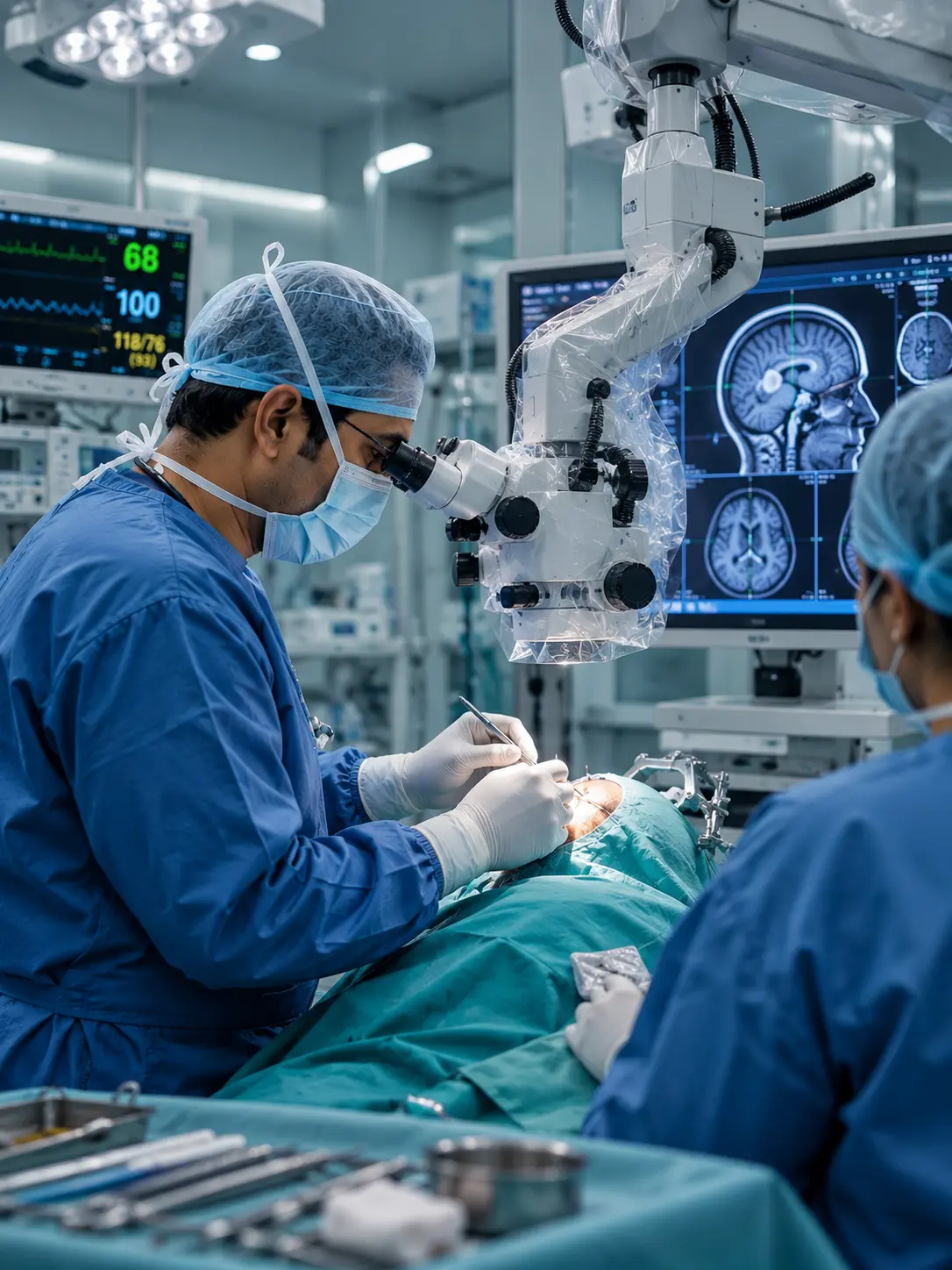
Neurosurgery covers more ground than most people expect. Brain tumors and head injuries get the attention, but a large share of what this department actually sees is spine-related. A disc pressing on a nerve. A fracture that’s compressed the spinal cord. Back pain that physiotherapy hasn’t touched. Then there’s the emergency end of it: a road accident with a skull fracture, a bleed inside the brain that has to be evacuated within hours, not days.
Children get separate consideration, too. A pediatric brain tumor or a congenital condition like spina bifida is not treated the same way it would be in an adult, and this department handles both without needing to refer the case out.
Most patients are from Kurukshetra town, but a fair number travel in from Pehowa, Ladwa, Shahabad, and the villages around them, often after a first opinion elsewhere didn’t give them a clear next step.
When the condition allows for it, spine and nerve procedures use smaller incisions and aim for a shorter recovery.
Hematoma evacuation, fracture stabilization, and other cranial or spinal trauma work don't wait for the next available slot.
Congenital defects, pediatric brain tumors, and trauma in children stay within this department rather than getting referred elsewhere.
Trigeminal neuralgia and carpal tunnel are two examples of conditions handled with a targeted procedure instead of full surgery, when that's appropriate.
Brain & Spine Surgeries
Years of Neurosurgical Experience
Cranial & Spinal Trauma Care
Physiotherapy & Rehabilitation Support
I'd been putting up with a slipped disc for over a year, in and out of physiotherapy with no real change. Dr. Mamik explained I could go the minimally invasive route instead of open surgery. Recovery was noticeably quicker than what my neighbor went through with the old-style surgery years ago. I was moving around within days.
My brother was in a road accident and had a skull fracture with bleeding inside his head. We got him in and they took him straight in for surgery to evacuate the bleed, no time wasted on paperwork or anything. Those hours are still hazy to me, but he pulled through and is recovering now. Grateful doesn't even cover it.
I'd had facial pain for years that medication just wasn't touching, sharp and sudden, out of nowhere. Turned out to be trigeminal neuralgia. Dr. Mamik suggested RF ablation instead of open surgery, targeting the nerve directly. It's been months since and the episodes have dropped off significantly. Wish I'd gotten it checked sooner.
Spine surgery done through smaller incisions than the traditional open approach, usually for disc prolapse and similar conditions. Whether it’s an option for you comes down to imaging and an exam, not a blanket rule.
Tumors get monitored based on size, location, and how fast they’re growing. Others need surgery, occasionally on short notice. Either way, it’s a case-by-case call after proper imaging.
Yes, 24 hours a day, including skull fracture management and hematoma evacuation. If it’s an accident or head injury, come in right away rather than booking an appointment for later.
Yes. Dr. Neha Kaushal recommends IUI after a thorough evaluation of the couple. The department handles the hormonal assessment, cycle monitoring and the procedure itself. If you require a fertility treatment more advanced than IUI, she will be upfront with you about the next steps.
Could be trigeminal neuralgia, a nerve condition that causes sharp facial pain. RF ablation targets the nerve directly without full surgery, but facial pain has more than one possible cause, so it needs a proper diagnosis first.
Yes. A good number of patients come from Pehowa, Thanesar, Shahabad, Ladwa, and Pipli, particularly for spine consultations and trauma cases.